
Protocols
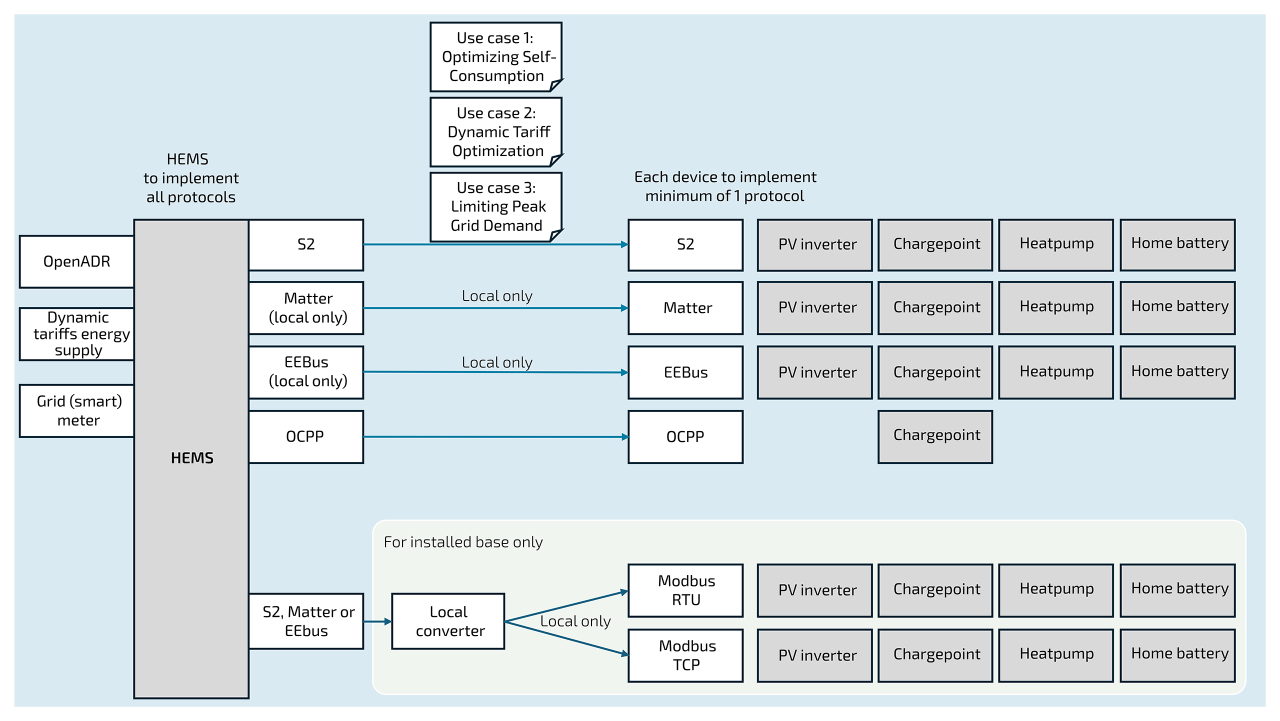
In current practice, a wide variety of communication protocols and methods are used to control and coordinate devices in and around the home for residential flexibility. At present, a HEMS service must integrate at least 10 to as many as 25 communication protocols to achieve a basic level of interoperability.
Market research has shown that limiting the number of protocols is necessary to improve interoperability. This applies to both communication to the home and within the home.
For communication from the outside world to the home, OpenADR has been chosen for communication with the grid operator, as it is already used for communication between DSOs and CPOs for public charging stations and is considered a future-proof solution. No protocol had to be selected for communication with energy suppliers, as market participants have indicated that there is currently no barrier—nearly all parties use the same API for this communication. Also, the existing interface of the smart meter can be used to determine the energy flows to and from the home. This is already standardized within the Netherlands.
For communication within the home, four future-proof international protocols have been selected that can be applied to new devices: OCPP, EEbus, Matter, and S2. Modbus is also part of the scope for achieving interoperability, but not as a standard for new devices—rather, it is used to connect already installed devices, which often use Modbus as their communication protocol.