The programme addresses three concrete situations in which home devices can respond intelligently to the energy system.
Peak Demand Limiting
The HEMS sends power envelope constraints to connected devices, limiting their consumption during congestion events. Devices must interpret and execute these limits within defined response times, with fallback behaviour when communication is lost.
Dynamic Tariff Response
The HEMS translates dynamic price signals into device-level control instructions: shifting or shaping load profiles in response to time-of-use tariffs. Requires reliable telemetry and schedule-based control.
Self-Consumption Optimisation
The HEMS monitors local generation and steers flexible loads to absorb surplus. Requires real-time production telemetry and responsive device control.
Five protocols bridge the HEMS and flexible devices. Click a protocol to jump to its work package.
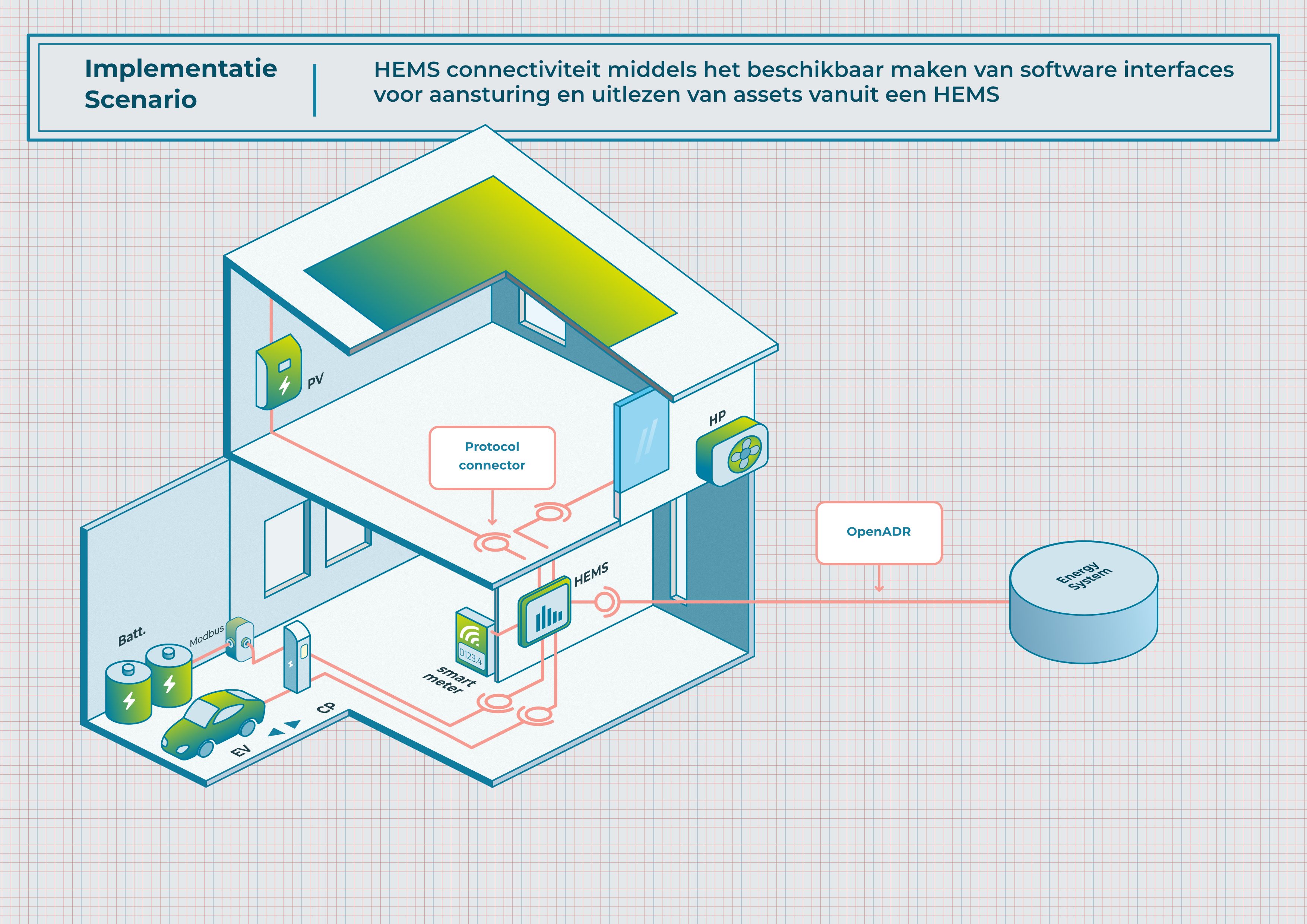
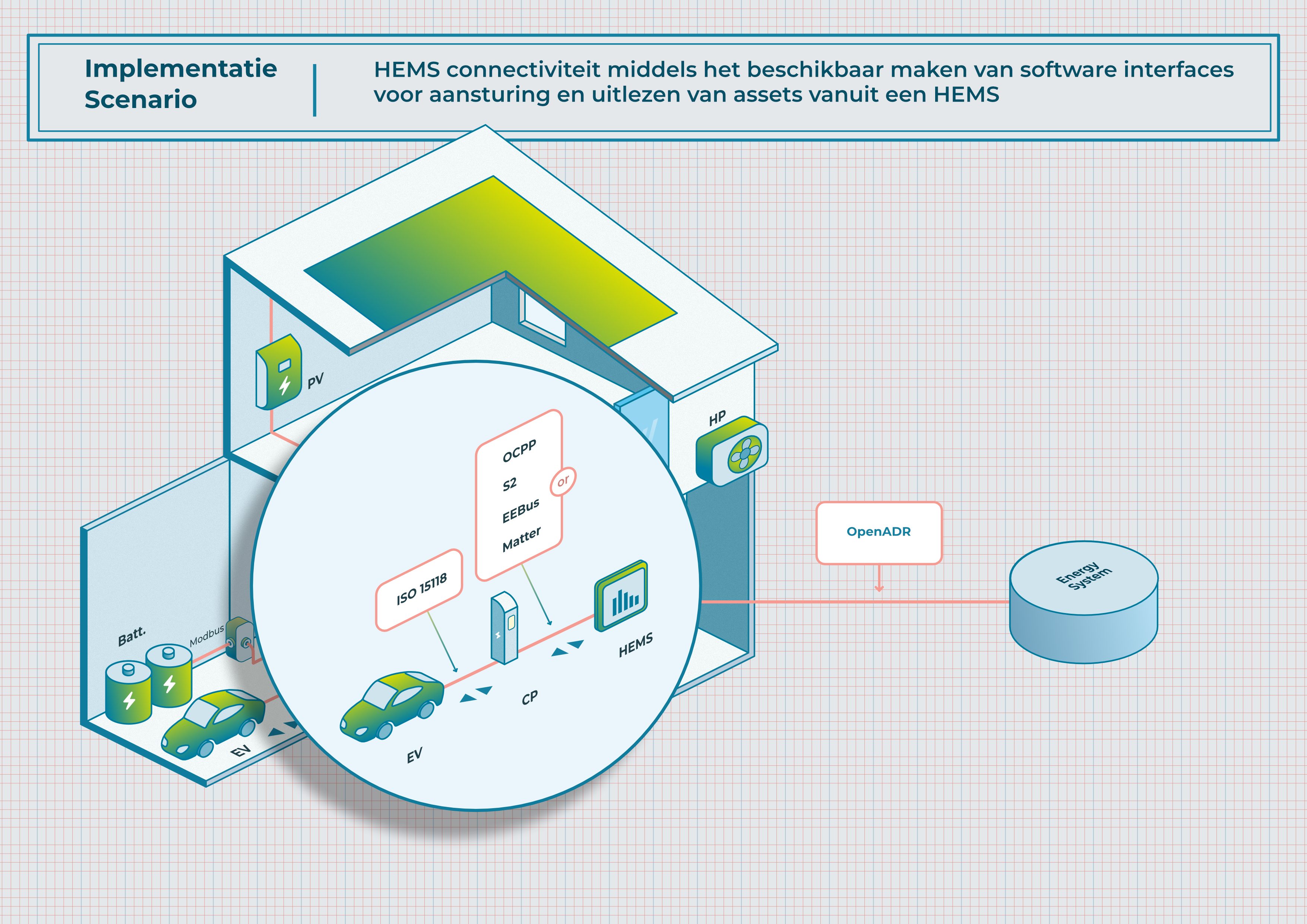
Click any card to explore details.
S2 Protocol
Implements the S2 protocol (EN 50631-1) for bidirectional HEMS-device communication. Covers PEBC (Power Envelope Based Control) and CEM resource management messages over SPINE/SHIP transport layer.
Matter
Implements Matter energy clusters (EVSE, Energy Management) enabling HEMS control of Matter-certified devices. Covers commissioning, fabric management, and real-time telemetry over Thread and Wi-Fi transports.
EEBUS
Implements the EEBUS Limitation of Power Consumption (LPC) use case over SPINE/SHIP. Covers device discovery, certificate-based security, heartbeat, and congestion management signalling between CEM and energy-intensive devices.
Modbus Converter
A protocol bridge translating Modbus TCP/RTU register maps to S2 resource descriptions and control messages. Supports configurable device profiles (inverters, batteries, meters) and exposes a standardised S2 interface to the HEMS.
OCPP Local HEMS
Implements a local OCPP 2.0.1 CSMS (Central System) within the HEMS, enabling direct charging profile management, smart charging via ISO 15118, and local fallback operation when cloud connectivity is unavailable.
Join the test events
These are not paper concepts. They are concrete implementations — built in open source, with a direct pathway into live interoperability testing at the ElaadNL Test Lab. Organizations not involved in the software build phase are also welcome.
Register for the test events →